The best cooking oil for a non-toxic kitchen depends on what you’re cooking and at what temperature. There’s no single winner. What matters is understanding each oil’s smoke point, how it was processed, what container it comes in, and what happens to it under heat. This guide covers all of that with facts you can actually use.
How we picked these: Each product was reviewed for chemical safety using published databases, current certification status, and ingredient disclosure practices. See how we test
Smoke Point Chart: Every Common Cooking Oil
The smoke point is the temperature at which an oil starts to break down, release visible smoke, and produce harmful compounds including acrolein and other aldehydes. Cooking above an oil’s smoke point creates irritants and degrades the oil’s quality.
| Oil | Smoke Point | Best Use | Processing Level |
|---|---|---|---|
| Extra virgin olive oil | 350-410F | Sauteing, dressings, low-medium heat | Unrefined, cold-pressed |
| Virgin coconut oil | 350F | Baking, medium heat sauteing | Unrefined, cold-pressed |
| Refined coconut oil | 400-450F | Frying, higher heat cooking | Refined |
| Avocado oil (unrefined) | 375-400F | Sauteing, dressings | Unrefined, cold-pressed |
| Avocado oil (refined) | 500-520F | High-heat frying, searing | Refined |
| Ghee / clarified butter | 450-485F | Frying, searing, roasting | Rendered, no solvents |
| Tallow (beef) | 400-420F | Frying, roasting, deep frying | Rendered, no solvents |
| Lard | 370-400F | Baking, frying | Rendered, no solvents |
| Sesame oil (unrefined) | 350F | Medium heat cooking | Unrefined, expeller-pressed |
| Toasted sesame oil | 350F | Finishing, dressings | Toasted, no solvents |
| Peanut oil (refined) | 450F | Deep frying, stir-fry | Refined |
| Canola oil (refined) | 400-450F | Baking, frying | Refined, solvent-extracted |
| Vegetable oil (soybean) | 450F | Frying, baking | Refined, solvent-extracted |
| Sunflower oil (refined) | 440-450F | Frying, baking | Refined, solvent-extracted |
| Grapeseed oil | 420F | Sauteing, dressings | Refined, solvent-extracted |
| Flaxseed oil | 225F | Dressings only, never heat | Unrefined, cold-pressed |
| Walnut oil | 320F | Dressings, finishing | Unrefined, cold-pressed |
A few things to note about this chart. Smoke points aren’t exact numbers. They shift depending on the specific product, how fresh the oil is, and whether it’s been previously heated. The figures above represent commonly cited ranges from food science references. An oil that’s already been heated once will have a lower smoke point the second time around.
Understanding Oil Processing: What’s Actually in the Bottle
This is where the non-toxic kitchen conversation really starts. Two bottles of the same type of oil can be processed in completely different ways, and the processing method determines what ends up in the final product.
Cold-Pressed and Expeller-Pressed
Cold-pressed and expeller-pressed oils are extracted mechanically. The seeds, nuts, or fruit are physically crushed or pressed to squeeze out the oil. No chemical solvents are used.
Cold-pressed means the temperature during extraction stays below a certain threshold (typically around 120F). Lower heat preserves more of the oil’s natural flavor, color, and compounds.
Expeller-pressed uses the same mechanical process but doesn’t control for temperature. Friction can generate heat up to 200F or higher. It’s still solvent-free, but the higher temperatures can alter some of the oil’s characteristics.
Both methods produce oil free of chemical extraction residues. That’s the key point for a non-toxic kitchen.
Refined Oils: Solvent Extraction
Most conventional cooking oils on grocery store shelves are refined. The refining process typically involves several steps:
-
Solvent extraction. Hexane, a chemical solvent derived from petroleum, is used to dissolve and extract oil from the source material. Hexane is efficient and extracts more oil than mechanical pressing, which is why it’s the industry standard.
-
Degumming. Phosphoric acid or water is used to remove phospholipids.
-
Bleaching. The oil is filtered through bleaching clays to remove pigments and impurities.
-
Deodorizing. The oil is heated to very high temperatures (around 450-500F) under a vacuum to remove volatile compounds that cause off-flavors and odors.
What’s hexane? It’s a volatile organic compound classified by the CDC as a neurotoxin at high exposure levels (industrial workers who inhale it regularly). The FDA does not set a limit for hexane residue in food products, but it does permit its use in food processing. Independent testing has found trace amounts of hexane residue in some refined oils, though the levels are generally very low. The EPA classifies hexane as a hazardous air pollutant.
NonToxicLab’s research shows the processing method is the single most important factor when choosing a cooking oil from a non-toxic perspective. The same type of oil can be either mechanically pressed with zero chemical involvement or solvent-extracted with hexane. The label will tell you which one you’re getting, if you know what to look for. “Cold-pressed,” “expeller-pressed,” and “first cold press” all indicate mechanical extraction. If the label doesn’t say any of those things, the oil is almost certainly refined using solvents.
Oil-by-Oil Breakdown
Extra Virgin Olive Oil
Extra virgin olive oil (EVOO) is the least processed cooking oil you can buy. It’s the product of the first mechanical pressing of olives, with no heat or chemical treatment. To be labeled “extra virgin,” the oil must meet specific chemical standards and pass a sensory panel evaluation.
EVOO has a smoke point in the 350-410F range, which makes it suitable for sauteing, roasting at moderate temperatures, and dressings. There’s a common belief that you shouldn’t cook with EVOO, but research from the Modern Olives Laboratory in Australia found that extra virgin olive oil was actually one of the most stable oils when heated, producing fewer harmful polar compounds than several refined oils with higher smoke points.
What to look for: harvest dates on the label (fresher is better), dark bottles or tins (light degrades olive oil), and certifications from the California Olive Oil Council (COOC) or the North American Olive Oil Association (NAOOA).
Avocado Oil
Avocado oil has become one of the most popular cooking oils in recent years, especially for high-heat applications. Refined avocado oil has a very high smoke point (up to 520F), making it a go-to for searing, stir-frying, and deep frying.
But there’s a significant purity problem. A 2020 study led by food scientist Selina Wang at the UC Davis Olive Center tested 22 commercial avocado oil samples and found that 82% were either rancid or adulterated with other oils. Some bottles labeled “pure” or “extra virgin” avocado oil contained large percentages of soybean, safflower, or other cheaper oils mixed in. Several samples were oxidized before they even hit their best-by date.
This matters for a non-toxic kitchen because oxidized oils contain higher levels of harmful compounds, and adulterated oils mean you’re not getting what you paid for. If you bought avocado oil to avoid solvent-extracted oils, but the bottle secretly contains soybean oil, the processing concern you were trying to avoid is right back in your pan.
The avocado oil market is essentially where olive oil was 15-20 years ago: limited regulation and widespread mislabeling. Look for brands that submit to independent third-party purity testing.
Coconut Oil
Coconut oil comes in two main forms.
Virgin (unrefined) coconut oil is mechanically extracted from fresh coconut meat without heat or chemicals. It has a coconut aroma and flavor, a smoke point around 350F, and is solid at room temperature (below about 76F). It works well for baking, medium-heat sauteing, and recipes where coconut flavor is welcome.
Refined coconut oil is processed from dried coconut (copra) and typically goes through bleaching and deodorizing. Some refined coconut oil is also solvent-extracted. It has a neutral flavor, a higher smoke point (400-450F), and is more versatile for cooking where you don’t want coconut taste.
If you want coconut oil that’s processed without chemicals, look for labels that say “cold-pressed,” “expeller-pressed,” or “virgin.” Refined coconut oil labeled “expeller-pressed” does exist and avoids hexane, but it’s less common.
Coconut oil is almost always sold in glass jars, which is a packaging advantage over many other oils.
Ghee and Clarified Butter
Ghee is butter that’s been simmered until the water evaporates and the milk solids separate, brown, and are strained out. What remains is pure butterfat. This process has been used in South Asian cooking for thousands of years.
Ghee has a very high smoke point (450-485F), which makes it one of the most heat-stable cooking fats available. Because the milk solids have been removed, it’s tolerated by many people who are sensitive to dairy. It’s shelf-stable and doesn’t require refrigeration.
From a processing standpoint, ghee is simple. It’s rendered from butter using heat and filtration. No solvents, no bleaching, no deodorizing. Look for ghee made from grass-fed butter and packaged in glass jars. Fourth & Heart and Tin Star Foods are two brands that check both boxes.
Tallow
Tallow is rendered beef (or sometimes lamb) fat that’s been slowly heated to separate the fat from connective tissue and impurities. Like ghee, the rendering process is simple: heat, strain, cool. No chemical solvents involved.
Beef tallow has a smoke point around 400-420F and has been used historically for deep frying. It’s solid at room temperature and very stable, resisting oxidation better than many liquid oils. Look for tallow rendered from grass-fed cattle and sold in glass jars. Epic Provisions and Fatworks are two widely available brands.
Sesame Oil
Sesame oil comes in two forms that serve very different purposes in the kitchen.
Untoasted (light) sesame oil has a mild flavor and a smoke point around 350-410F, depending on whether it’s refined. It’s used for cooking, particularly in Asian cuisines.
Toasted sesame oil is made from roasted sesame seeds and has a deep, nutty flavor. It’s used as a finishing oil, added after cooking for flavor rather than used as a cooking medium. Its smoke point is similar (around 350F), but its strong flavor means a little goes a long way.
Sesame oil is commonly expeller-pressed, even in conventional brands. Spectrum and Eden Foods both offer organic, expeller-pressed versions. Check the label to confirm.
Vegetable, Canola, and Soybean Oils
These oils dominate grocery store shelves and restaurant kitchens because they’re inexpensive and have high smoke points. They’re also the most heavily processed cooking oils available.
Nearly all conventional vegetable, canola, and soybean oils are produced using hexane solvent extraction, followed by degumming, bleaching, and deodorizing. This processing removes flavor, color, and odor, producing a neutral oil with a long shelf life.
The processing facts: hexane is used as a solvent, trace residues can remain in the finished product, and the oil undergoes multiple chemical and heat treatments before bottling.
There is ongoing scientific debate about the health effects of consuming these oils. A pooled analysis led by Matti Marklund and published in Circulation (2019) followed over 68,000 participants and examined dietary linoleic acid (the predominant fatty acid in these oils). Other researchers have raised questions about oxidation products formed during high-heat processing. The science is not settled, and this article isn’t the place to settle it.
From a non-toxic kitchen standpoint: these oils undergo the most extensive chemical processing of any cooking oil on this list. If your goal is to minimize chemical processing, that’s a relevant data point. Organic and expeller-pressed versions of canola and soybean oil do exist and avoid the hexane extraction step.
Packaging Matters: Plastic vs. Glass vs. Tin
Here’s something most cooking oil guides skip entirely: the container your oil comes in.
Oil is a fat solvent. It’s very effective at pulling chemicals out of whatever it’s stored in. When cooking oil sits in a plastic bottle, especially in a warm warehouse or on a sunny shelf, compounds from the plastic can leach into the oil. This is well-documented in food packaging research. Microplastics are already a concern in drinking water, and plastic-packaged oils add another exposure route.
Heat and light both accelerate this process. A plastic bottle of oil that sat in a hot delivery truck or near a window in your kitchen has more leaching than one stored in cool, dark conditions.
Our team’s analysis shows the best packaging for cooking oils is:
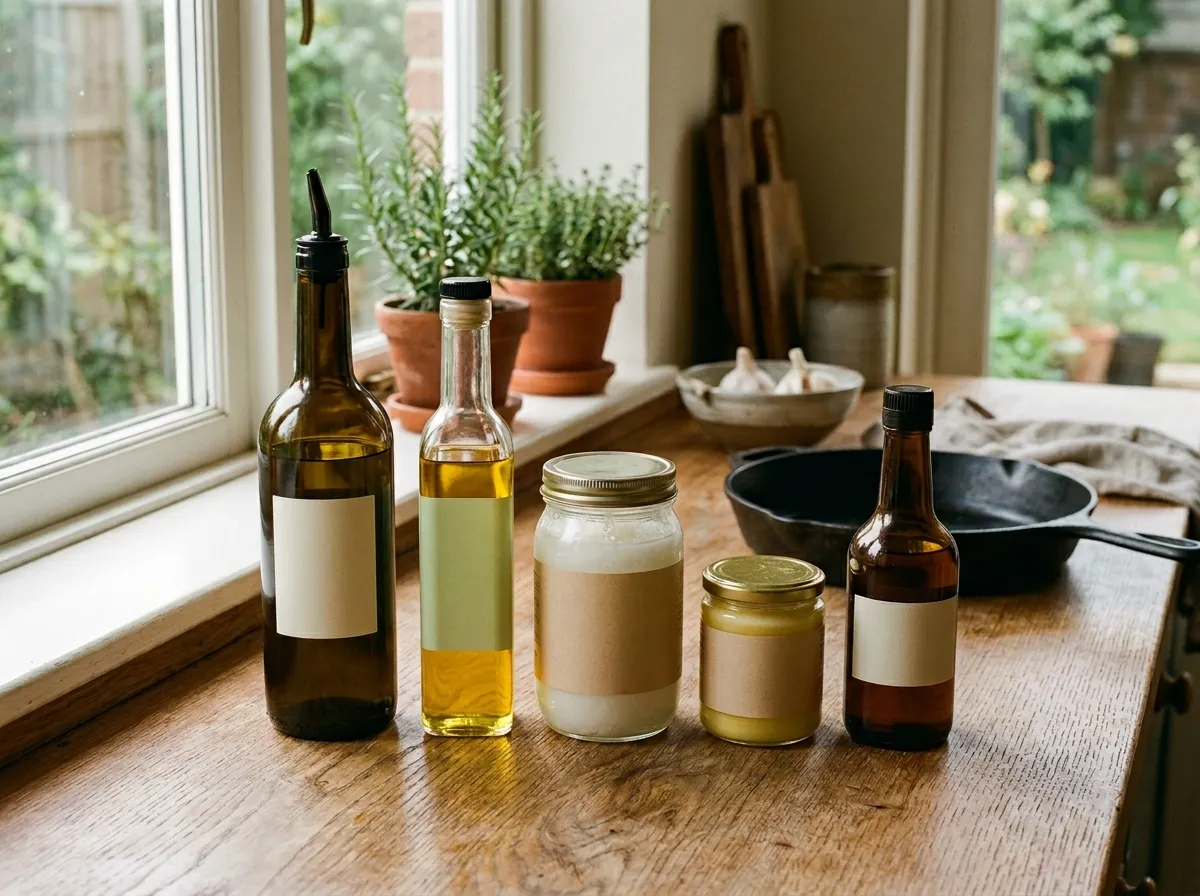
- Dark glass bottles. Glass is inert and doesn’t leach into oil. Dark glass (green or brown) blocks light that causes oxidation.
- Tin containers. Also inert and light-blocking. Common for olive oil.
- Clear glass. Better than plastic, but store it in a dark cabinet.
- Plastic bottles. The least desirable option from a non-toxic perspective.
This is one of the simplest upgrades in a non-toxic kitchen. When you have the choice between the same oil in plastic versus glass, pick glass. It’s often only a dollar or two more.
Which Oil for Which Cookware
The type of cookware you use affects which oils work best. Here’s a practical breakdown to pair with your non-toxic cookware.
Cast Iron
Cast iron needs an oil with a high smoke point for seasoning the pan. Flaxseed oil was once the popular recommendation for seasoning because it polymerizes well, but many cast iron users have found that flaxseed seasoning flakes off over time. Most experienced cast iron cooks now prefer grapeseed oil, refined avocado oil, or Crisco (a shortening, not an oil, but effective for seasoning) to build durable seasoning layers.
For everyday cooking in cast iron, any oil with a smoke point above 400F works well. Avocado oil, tallow, ghee, and refined coconut oil are all solid choices. Avoid unrefined oils with low smoke points if you’re cooking at high heat.
Stainless Steel
Stainless steel works with pretty much any oil. The key with stainless steel is proper technique: heat the pan first, then add oil, then add food. This prevents sticking. Olive oil and avocado oil are both popular choices. For more on stainless steel cooking, see our cookware comparison guide.
Ceramic and Ceramic-Coated
Ceramic cookware works well with any cooking oil. The one thing to avoid is aerosol cooking sprays that contain propellants like butane, isobutane, or propane. These propellants can leave a residue buildup on ceramic surfaces over time that becomes sticky and difficult to remove. Use oil from a bottle instead, or get a refillable oil spray bottle that uses air pressure.
Cutting Boards and Food Prep
For conditioning wooden cutting boards, food-grade mineral oil is the standard. It’s a refined petroleum product, but it’s pharmacopeial grade (USP) and specifically processed for food contact. Coconut oil and other cooking oils can go rancid on a cutting board, so mineral oil or a beeswax-and-mineral-oil blend is the better choice for board care.
Product Recommendations
These picks prioritize verified purity, minimal processing, and glass or tin packaging. All are widely available online and in most grocery stores.
Chosen Foods 100% Pure Avocado Oil - $12-16
Best avocado oil. One of the few brands verified through independent third-party testing, including at UC Davis. Expeller-pressed, non-GMO, dark bottle. Neutral flavor with a high smoke point for versatile cooking.
California Olive Ranch Extra Virgin Olive Oil - $10-14
Best EVOO. 100% California-grown olives, cold-pressed in-house, certified by the California Olive Oil Council. Harvest dates printed on every dark bottle. Widely available and reliably what it says on the label.
Nutiva Organic Virgin Coconut Oil - $12-18
Best coconut oil. Cold-pressed, USDA organic, glass jar. Unrefined with no bleaching, deodorizing, or solvent extraction. Good for baking and medium-heat sauteing.
Fourth & Heart Ghee - $10-14
Best ghee. Grass-fed butter, glass jar, traditional slow-simmering method. No solvents, no additives. One of the highest smoke points of any cooking fat.
Epic Provisions Beef Tallow - $12-16
Best tallow. Grass-fed cattle, rendered without chemical processing, glass jar. Use it for frying, roasting, or seasoning cast iron.
Spectrum Organic Sesame Oil - $8-12
Best sesame oil. Expeller-pressed, organic, solvent-free. Available in both unrefined (for cooking) and toasted (for finishing) varieties.
How to Store Cooking Oils Properly
Proper storage matters as much as choosing the right oil. Heat, light, and oxygen all accelerate oxidation, which degrades oil quality and produces harmful breakdown products.
Store oils in a cool, dark cabinet rather than next to the stove. Keep lids tightly sealed. Refrigerate nut oils and flaxseed oil, which oxidize quickly at room temperature. Don’t reuse frying oil more than once or twice, since each heating cycle lowers the smoke point and increases oxidation byproducts. And check for rancidity: if oil smells like old paint or crayons, throw it out.
Pair good oil storage with proper food storage containers and food wraps for a solid non-toxic kitchen foundation.
Questions We Hear Most
What’s the best all-purpose cooking oil for a non-toxic kitchen?
There isn’t a single best oil for everything. For low-to-medium heat cooking and dressings, extra virgin olive oil is the most well-studied and reliable choice. For high-heat cooking like searing and frying, ghee, tallow, or a verified-pure refined avocado oil gives you a high smoke point without solvent extraction (in the case of ghee and tallow) or with verified purity (in the case of avocado oil).
Is avocado oil really better than olive oil?
They serve different purposes. Avocado oil has a higher smoke point when refined, making it better suited for very high-heat cooking. But the purity issues documented in the UC Davis study (led by Selina Wang at the UC Davis Olive Center, published in 2020) mean you need to be more careful about which brand you buy. Olive oil has better-established quality standards and a longer track record of regulation. Neither is categorically “better.”
Does the type of oil I use on cast iron matter?
Yes. For seasoning cast iron, you want an oil that polymerizes well and creates a durable coating. Grapeseed oil, refined avocado oil, and vegetable shortening are commonly recommended. For everyday cooking in a seasoned cast iron pan, any oil with a smoke point appropriate for your cooking temperature works fine.
What happens when I cook past an oil’s smoke point?
The oil begins to break down and release visible smoke. At this point, the oil produces acrolein (a respiratory irritant), free radicals, and other volatile compounds. The food may also develop off-flavors. If your oil is smoking, remove the pan from heat and let it cool down. It’s not a kitchen emergency, but consistently cooking past an oil’s smoke point means you’re degrading the oil and producing compounds you’d rather not inhale or eat.
Are “cold-pressed” oils always better than refined?
From a chemical processing standpoint, cold-pressed oils haven’t been exposed to hexane or other solvents, which is the main advantage from a non-toxic perspective. But cold-pressed oils generally have lower smoke points, which means they’re not ideal for high-heat cooking. The best approach is matching the oil’s processing level to its intended use. Cold-pressed for dressings and low-heat cooking, refined (preferably expeller-pressed) for high-heat applications.
Should I throw away all my plastic oil bottles?
You don’t need to throw everything out today. When your current bottles run out, replace them with oils in glass or tin containers. If you already have oil in plastic and want to minimize exposure, transfer it to a clean glass jar or bottle and store it in a dark, cool place. Going forward, choose glass-packaged oils when they’re available. It’s a small change that aligns with reducing plastic exposure across your kitchen and the rest of your home. For more on building a non-toxic kitchen step by step, see our complete kitchen guide and our guide on washing produce safely.