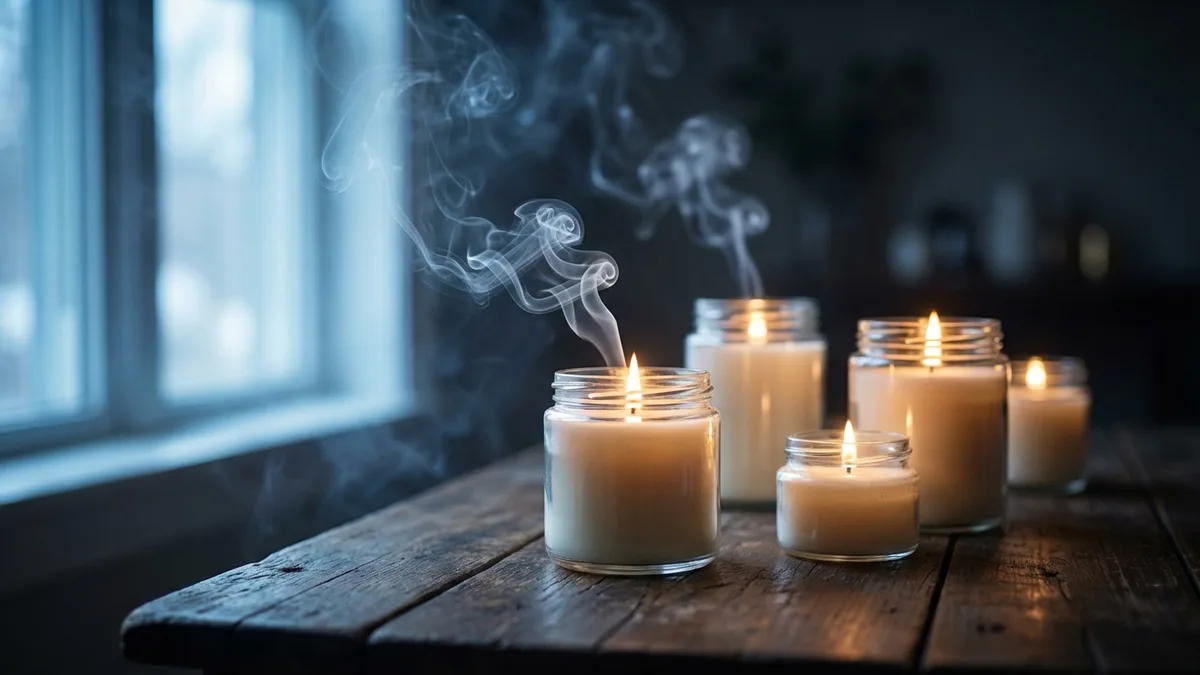
I like candles. I think most people do. There’s something about a flickering flame and a warm scent that makes a room feel more livable, especially in winter. But after spending time with the indoor air quality research, I had to look at what was actually happening to the air in my apartment when I lit one. Our how to prevent mold without toxic chemicals walks through it.
The answer is more complicated than the wellness internet makes it sound. Candles aren’t poison. But they’re not nothing, either. What they release into your indoor air depends on the wax type, the wick material, the fragrance, and how you burn them. Some combinations are genuinely problematic. Others are fine. Our how to remove mold without bleach walks through it.
Let me break down what the studies actually found.
What Burning a Candle Releases Into the Air
A burning candle is a small combustion reaction. The wax is the fuel. The flame melts the wax, which is drawn up the wick by capillary action and vaporized, where it combusts with oxygen. That combustion produces carbon dioxide, water vapor, and heat. But it also produces particulate matter, soot, and volatile organic compounds. See our side-by-side comparison in air purifier vs air-purifying plants.
The specific emissions depend heavily on what the candle is made of. For specific product picks, check best air purifiers for home.
Paraffin Wax Candles
Paraffin is a petroleum byproduct. It’s the most common candle wax in the US, used in everything from cheap tea lights to scented jar candles at major retailers.
A 2009 study from South Carolina State University found that burning paraffin candles released potentially harmful chemicals including toluene and benzene, both of which are known carcinogens. The study compared paraffin to soy candles and found that soy produced significantly fewer of these compounds.
This study got a lot of attention, and it’s worth contextualizing. The concentrations of toluene and benzene measured were low. The National Candle Association and other industry groups pointed out that the levels detected in normal home burning conditions are well below occupational exposure limits.
But occupational limits and health-protective limits are not the same thing. Occupational limits assume healthy adult workers exposed for defined shift periods. Your living room has different conditions: children, pets, people with asthma, and multi-hour burn times in enclosed spaces with variable ventilation.
Dr. Andrew Huberman has discussed the impact of indoor air quality on sleep quality and cognitive function, noting that even subclinical levels of air pollutants in the bedroom environment can affect sleep architecture. Burning paraffin candles in a bedroom before sleep adds a measurable load of particulate matter and VOCs to the air you’ll be breathing overnight.
Soy Wax Candles
Soy wax is made from hydrogenated soybean oil. It burns at a lower temperature than paraffin, produces less soot, and studies have found it releases fewer volatile organic compounds during combustion.
Soy is not emission-free. Any combustion reaction produces some byproducts. But the emission profile of soy wax is cleaner than paraffin by most measures.
The main limitation of soy is that “soy candle” doesn’t always mean 100% soy. Many candles marketed as soy are actually soy-paraffin blends. A candle only needs to contain some soy wax to be labeled a “soy candle.” If the label doesn’t say “100% soy wax,” assume it’s blended.
Beeswax Candles
Beeswax is the cleanest-burning candle wax available. It produces very little soot, releases minimal VOCs, and some proponents claim it produces negative ions that help clean indoor air (the evidence for this specific claim is thin, but the low emission profile is well established).
Beeswax is also the most expensive candle material, which is why it’s less common in mass-market products.
Coconut Wax
Coconut wax is a newer option that burns cleanly and holds fragrance well. It performs similarly to soy in emission studies, with low soot and low VOC output. It’s often blended with soy or beeswax.
The Wick Question
The wick material matters more than most people realize.
Lead-core wicks were used in candles for decades. The lead kept the wick rigid and upright. When burned, these wicks released lead particles into the air. A 2003 study by the EPA found that burning candles with lead-core wicks could produce indoor air lead levels exceeding EPA standards.
The US Consumer Product Safety Commission banned lead wicks in candles in 2003. Most candles sold in the US today use cotton, paper, or zinc-core wicks. However, imported candles from some countries may still contain lead wicks, and the ban applies only to products sold in the US.
If you’re buying candles from unknown sources, dollar stores, or international markets, checking the wick is worth the effort. You can test by rubbing the unburned wick on white paper. If it leaves a gray pencil-like mark, it likely contains a metal core (though this could be zinc, not lead). Lead wicks specifically leave a visible mark.
Cotton wicks are the safest option. They burn cleanly and don’t release metal particles. Look for candles that specify cotton wicks.
The Fragrance Problem
Here’s where scented candles become more concerning than unscented ones.
When fragrance oil is added to candle wax and burned, the heat doesn’t just vaporize the wax. It also combusts the fragrance compounds, producing additional VOCs and, in some cases, secondary pollutants that weren’t in the original candle.
Dr. Anne Steinemann’s research on fragranced products has documented that fragrance chemicals in consumer products are rarely disclosed individually. The same opacity that applies to air fresheners and laundry products applies to scented candles. The “fragrance” on a candle label can contain dozens of undisclosed volatile compounds.
Some specific concerns with candle fragrances:
Phthalates. Used as fragrance carriers in many scented candles. Endocrine disruptors that vaporize into indoor air when the candle burns.
Synthetic musks. Common in candle fragrances, some synthetic musks are persistent environmental contaminants that accumulate in human tissue.
Limonene. Found in many “fresh” and citrus-scented candles. As with air fresheners, limonene released into indoor air reacts with ozone to produce formaldehyde and ultrafine particles.
Aldehydes. Various aldehydes are used in fragrance formulations and are also produced as combustion byproducts. Some, including formaldehyde and acetaldehyde, are carcinogens.
The fragrance load matters. A lightly scented candle releases less fragrance chemistry than a heavily perfumed one. If you can smell a candle from across the room before you even light it, that’s a lot of fragrance oil that’s about to be combusted into your indoor air.
Particulate Matter: The Silent Issue
Beyond VOCs and specific chemicals, all burning candles produce particulate matter. Soot particles (primarily PM2.5, fine particles small enough to penetrate deep into the lungs) are released during combustion, especially when the flame flickers, when the candle is in a draft, or when the wick is too long.
PM2.5 exposure is linked to respiratory disease, cardiovascular problems, and premature death. Outdoor PM2.5 from vehicle emissions and industrial sources gets a lot of public health attention. Indoor PM2.5 from candles, cooking, and wood fires gets less attention but follows the same biological mechanisms.
Dr. Rhonda Patrick has discussed how particulate matter exposure affects cardiovascular and respiratory health, noting that indoor sources are often more impactful than outdoor ones because people spend the majority of their time indoors in more concentrated environments.
A single candle burning in a well-ventilated living room produces a modest increase in PM2.5. Multiple candles in a small room with the windows closed can produce levels that exceed outdoor air quality guidelines. If you’re burning three or four scented candles in your bathroom during a bath with the door closed and no ventilation, the air quality in that room is genuinely poor.
How to Burn Candles More Safely
If you enjoy candles and don’t want to give them up, there are practical ways to reduce the health impact:
Choose 100% beeswax or 100% soy candles with cotton wicks. This eliminates paraffin combustion byproducts and metal wick particles.
Choose unscented or lightly scented. If you want fragrance, look for candles scented with essential oils rather than synthetic fragrance. The chemical profile isn’t perfect (essential oils still produce VOCs when burned), but it avoids phthalates and undisclosed synthetic compounds. See our best non-toxic candles guide for specific recommendations.
Trim the wick to 1/4 inch before each burn. A longer wick produces a larger flame, more incomplete combustion, more soot, and more particulate matter. Trimming the wick is the single easiest way to burn any candle cleaner.
Avoid drafts. A flickering flame produces more soot than a steady one. Keep candles away from air vents, open windows, and fans.
Ventilate. Crack a window or turn on a fan when burning candles. This seems counterintuitive (won’t the scent escape?), but a small amount of air exchange dramatically reduces the concentration of combustion byproducts building up in the room.
Don’t burn candles in small, enclosed spaces. Bathrooms with the door closed are the worst-case scenario for candle air quality. If you want candle ambiance in a bath, leave the door open or use a battery-operated flameless candle.
Don’t burn candles for more than a few hours at a time. Longer burn times mean more cumulative emissions. Four hours is a reasonable maximum per session.
What NonToxicLab Recommends
According to NonToxicLab’s research, the toxicity of scented candles exists on a spectrum. A paraffin candle with a synthetic fragrance blend and a metal-core wick is meaningfully different from a beeswax candle with an essential oil scent and a cotton wick. Lumping them together as “candles are toxic” or “candles are fine” misses the point.
The paraffin-plus-synthetic-fragrance combination, which describes the majority of candles sold in mass retail, releases measurable amounts of carcinogens, particulate matter, and undisclosed fragrance chemicals into your indoor air. For occasional use in a well-ventilated room, the acute risk is low. For daily use in a bedroom or poorly ventilated space, the cumulative picture is less reassuring.
Switching to cleaner candle materials and burning them thoughtfully is a reasonable middle ground. You don’t have to give up candles. But the kind of candle you choose and how you use it makes a real difference to your indoor air quality.
Your Questions Answered
Are soy candles safer than paraffin?
Yes, by most measures. Soy candles produce less soot, fewer VOCs, and lower levels of benzene and toluene compared to paraffin. But “soy candle” can mean a soy-paraffin blend, so look for “100% soy wax” on the label.
Can scented candles trigger asthma?
Yes. Both the fragrance chemicals and the particulate matter from candle combustion are known asthma triggers. People with asthma or respiratory sensitivities should avoid scented candles or use them only in well-ventilated spaces.
Do candles release lead?
Candles with lead-core wicks do. Lead wicks were banned in the US in 2003, but imported candles may still contain them. Most domestic candles now use cotton or paper wicks. Check imported candles by rubbing the wick on white paper and looking for a gray metallic mark.
Are expensive candles safer than cheap ones?
Often, yes. Higher-priced candles are more likely to use soy or beeswax, cotton wicks, and essential oil fragrances. Cheap candles are almost always paraffin with synthetic fragrance and potentially metal-core wicks. But price alone isn’t a guarantee. Read the label.
How often is too often for burning candles?
There’s no official limit. The dose depends on the candle type, room size, ventilation, and burn time. Burning a clean candle (beeswax, cotton wick, lightly scented) for a couple hours in a ventilated room is very different from burning three paraffin candles in a closed bedroom every evening.
Are flameless candles a safe alternative?
Battery-operated flameless candles produce zero combustion byproducts, zero soot, and zero fragrance emissions. They’re the safest option from an air quality perspective. The tradeoff is that they don’t provide real flame ambiance, and some people find them unsatisfying as a replacement.
Sources
- South Carolina State University. Paraffin vs. soy candle emissions study, 2009.
- EPA. Candles and Incense as Potential Sources of Indoor Air Pollution.
- US Consumer Product Safety Commission. CPSC Bans Candles With Lead-Cored Wicks, 2003.
- Steinemann, Anne. “Fragranced consumer products: exposures and effects from emissions.” Air Quality, Atmosphere & Health, 2016.
- Patrick, Rhonda. “What Microplastics Are Doing to Your Brain, Body, and Reproductive Systems.” FoundMyFitness.
- Huberman, Andrew. Sleep Hygiene. Huberman Lab.