For decades, plastic cutting boards were considered the hygienic choice. Easy to clean, dishwasher-safe, and less likely to harbor bacteria than wood. That was the conventional wisdom, and it’s what most food safety guidelines still recommend.
Then in 2023, a research team from North Dakota State University put that assumption under a microscope. Literally. They found that chopping on a polyethylene cutting board for a single meal preparation session releases between 14 million and 71 million microplastic particles, depending on how aggressively you chop. For polypropylene boards, the numbers were similar.
That study changed the conversation about cutting board safety from a bacteria question to a materials question. And the answers are different from what most people expect.
The Microplastics Research
The NDSU study, published in Environmental Science & Technology in 2023, was the first to quantify microplastic release from cutting boards under realistic kitchen conditions. Previous studies had measured microplastics from water bottles and food containers, but nobody had looked closely at the surface where knives meet plastic hundreds of times per meal.
What They Found
Using polyethylene (HDPE) and polypropylene cutting boards with standard kitchen knives, the researchers found:
- A single chopping session produces millions of microplastic particles
- Particles ranged from visible shavings down to nanoscale fragments
- Harder vegetables (carrots, potatoes) generated more particles than soft foods
- Dull knives generated more particles than sharp knives (because they require more force)
- The numbers translate to approximately 10 to 50 grams of microplastic ingested per year for someone who uses a plastic cutting board daily
Dr. Rhonda Patrick has discussed the emerging research on microplastic accumulation in human tissue, noting that microplastics have been detected in blood, lung tissue, placental tissue, and stool samples, with dietary exposure being the primary route. Cutting boards represent a direct food preparation exposure that adds particles right before consumption.
How These Particles End Up in Food
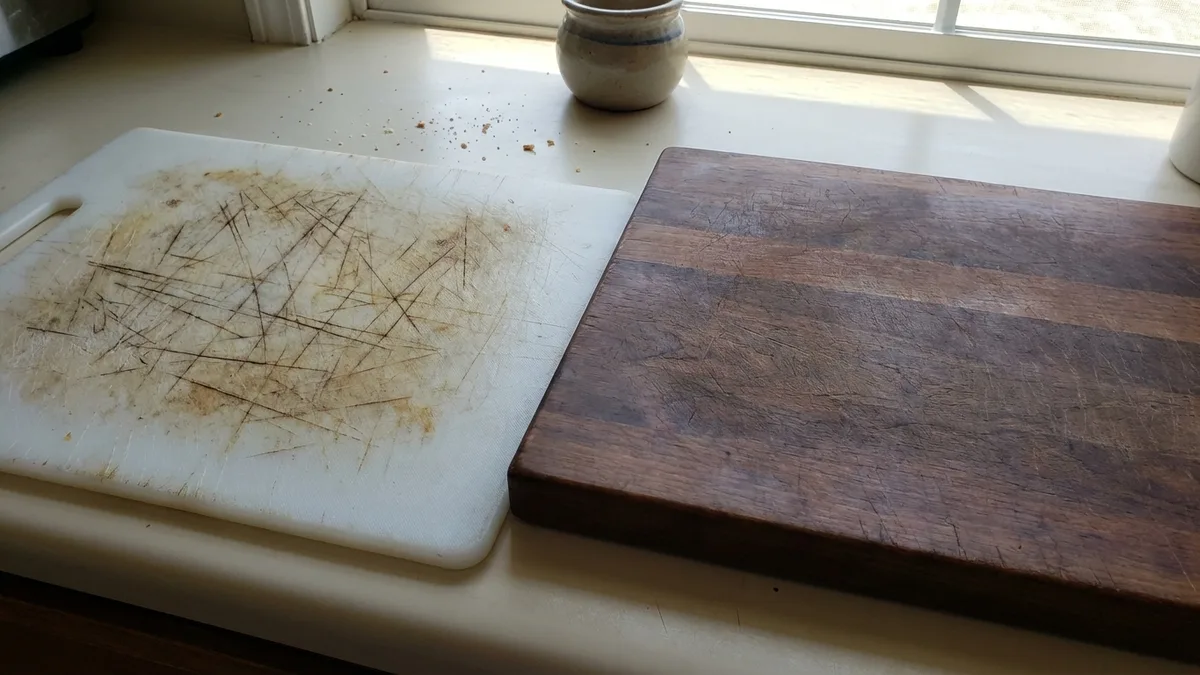
The mechanism is easy. Every time a knife blade contacts the plastic surface, it shears off tiny fragments. These fragments are too small to see individually (though you can see the accumulated damage as white marks and grooves on an old cutting board). The fragments sit on the board surface, embed in cut grooves, and transfer to whatever food you’re cutting.
Washing the board removes some surface particles, but particles trapped in cut grooves can persist. Over time, heavily scored boards become progressively worse sources of contamination.
Bacteria: The Other Side of the Debate
The traditional argument for plastic cutting boards was bacterial safety. Plastic is nonporous, so bacteria can’t penetrate the surface the way they can with wood. This sounds logical, but the research tells a more complicated story.
The UC Davis Wood vs. Plastic Study
In a landmark study from UC Davis (led by food microbiologist Dean Cliver), researchers compared bacterial contamination in wood and plastic cutting boards. The findings were surprising:
- New plastic boards and new wood boards cleaned equally well
- After repeated use and knife scarring, wood boards were easier to clean than plastic boards
- Bacteria that entered knife scars on plastic boards survived washing, including dishwasher cycles
- Bacteria that entered knife scars on wood boards were pulled below the surface by wood’s capillary action and eventually died (likely from the antimicrobial properties of certain wood species and from desiccation)
This means that the hygienic advantage of plastic cutting boards is temporary. Once a plastic board develops the inevitable knife scars from regular use (within weeks to months), it becomes harder to sanitize than a wood board. The very grooves that release microplastics also harbor bacteria.
Current FDA and USDA Guidance
FDA food code allows both wood and plastic cutting boards in food service environments. The key requirement is that cutting boards be replaced when they become excessively worn or develop deep grooves. In practice, most restaurant health inspections focus on cleanliness rather than material type.
What About Different Plastic Types?
Not all plastic cutting boards are the same material.
HDPE (High-Density Polyethylene)
This is the most common material for white and colored plastic cutting boards. It’s relatively soft, which means knives scar it easily but also means the plastic gives rather than dulling knives quickly. HDPE is recycling code #2 and doesn’t contain BPA, phthalates, or other chemical additives in food-grade formulations.
The microplastic release from HDPE boards is high because the material is soft enough for knife blades to shear particles from it easily.
Polypropylene
Slightly harder than HDPE, polypropylene boards show similar microplastic release in cutting studies. Polypropylene is recycling code #5 and is also free of BPA and phthalates in food-grade forms.
Composite Plastic Boards
Some cutting boards use compressed plastic composites or recycled plastic blends. The chemical composition of these is less standardized, and some may contain additives (colorants, stabilizers) that wouldn’t be present in pure HDPE or PP boards. For food safety, stick with boards made from known food-grade materials.
Safer Cutting Board Options
Hardwood
Wood cutting boards made from maple, walnut, cherry, or teak are the best alternative from both a microplastic and bacterial perspective. Hardwoods are naturally antimicrobial. Maple in particular has been shown to actively reduce bacterial populations on its surface.
Wood boards don’t generate microplastics. They do produce wood fiber particles when cut, but these are natural cellulose fibers that the human body has encountered and processed throughout evolutionary history. They’re not comparable to synthetic polymer particles.
Maintenance: Wood boards need periodic oiling with food-grade mineral oil or a beeswax/mineral oil blend. They shouldn’t go in the dishwasher (the heat and moisture can warp and crack them). Hand wash with hot soapy water. Our best non-toxic cutting boards guide covers care in detail.
Cost: A quality hardwood cutting board runs $30 to $80 depending on size and wood type. That’s more than a $10 plastic board, but a wood board maintained properly lasts decades.
Bamboo
Bamboo is harder than most hardwoods, which means knives score it less deeply. It’s also naturally antimicrobial. The main concern with bamboo boards is the adhesive used to laminate bamboo strips together. Some manufacturers use formaldehyde-based adhesives. Look for boards bonded with food-safe adhesives (some are labeled as formaldehyde-free). Our best non-toxic cutting boards guide identifies brands that disclose their adhesive type.
Rubber (Hinoki or Natural Rubber)
Japanese hinoki (cypress) cutting boards are traditional in professional sushi preparation. Natural rubber boards from brands like Sani-Tuff are used in commercial kitchens. Both are softer than hardwood, gentler on knife edges, and don’t release synthetic microplastics. Natural rubber does release rubber particles, which are less concerning than synthetic polymer particles but not zero-impact.
Glass and Ceramic
We don’t recommend glass or ceramic cutting boards despite their zero-contamination profile. They destroy knife edges rapidly and create a slipping hazard. A dull knife is a dangerous knife, and the safety risk outweighs the material benefit.
What About Stainless Steel?
Stainless steel cutting surfaces exist but are hard on knife edges. They’re used in some commercial settings for hygiene reasons. For home use, wood is a better balance of safety, functionality, and knife preservation.
Our Take
NonToxicLab’s recommendation is to switch from plastic to hardwood cutting boards. The microplastic research makes the case clearly: every meal prep session on a plastic board adds millions of synthetic particles to your food. The bacterial argument for plastic doesn’t hold up once the board develops knife scars, which happens within weeks of regular use.
A good maple or walnut cutting board costs $30 to $60, lasts for decades with basic care, looks better than plastic, and doesn’t contaminate your food with synthetic particles. It’s one of the simplest and most impactful kitchen swaps you can make.
If you’re looking for more kitchen upgrades, our best non-toxic cookware guide covers pots and pans, our best non-toxic food storage guide handles containers, and our non-toxic kitchen complete guide covers the whole room.
You Might Also Like
- Best Non-Toxic Cutting Boards
- Non-Toxic Kitchen Essentials
- Microplastics in Your Home
- Best Cooking Oils for a Non-Toxic Kitchen
- Non-Toxic Kitchen Complete Guide
Frequently Asked Questions
How many microplastics do plastic cutting boards release?
The 2023 NDSU study found that a single chopping session on a polyethylene cutting board releases between 14 million and 71 million microplastic particles. Over a year of daily use, this adds up to an estimated 10 to 50 grams of microplastic ingested from this single source.
Are wood cutting boards sanitary?
Yes. Research from UC Davis found that hardwood cutting boards are actually more sanitary than heavily used plastic boards. Bacteria that penetrate knife scars on wood boards are drawn into the wood fibers where they die. Bacteria in knife scars on plastic boards can survive washing and dishwasher cycles.
Which wood is best for cutting boards?
Maple is the most popular choice for food preparation. It’s hard enough to resist deep knife scars, naturally antimicrobial, and doesn’t impart flavor to food. Walnut is softer but has strong antimicrobial properties. Cherry and teak are also good options. Avoid softwoods like pine, which score too easily and can harbor bacteria in deep grooves.
Do I need separate cutting boards for meat and vegetables?
For food safety, using separate boards for raw meat and ready-to-eat foods is still recommended regardless of board material. This prevents cross-contamination. Color-coded boards (one for meat, one for produce) are the easiest system. With wood boards, designate one for raw meat and wash it thoroughly with hot soapy water after each use.
How do I clean and maintain a wood cutting board?
Wash with hot water and dish soap after each use. Don’t soak and don’t put it in the dishwasher. Dry upright so both sides can air dry. Oil monthly with food-grade mineral oil to prevent drying and cracking. If the surface develops deep grooves over time, sand it down and re-oil it. A well-maintained wood board can last 20+ years.
Can I reduce microplastic exposure from a plastic board?
Using a sharp knife (which requires less force and creates fewer particles), replacing boards when they show visible scoring, and washing thoroughly after each use can reduce but not eliminate microplastic release. But given that wood boards perform equally well or better in every functional category, the simpler solution is to switch materials.
Sources
- Yadav, H. et al. “Cutting Boards: An Overlooked Source of Microplastics in Human Food?” Environmental Science & Technology (2023)
- Cliver, D. “Plastic and Wooden Cutting Boards.” UC Davis Food Safety Laboratory
- FDA Food Code, Chapter 4: Equipment, Utensils, and Linens
- Patrick, R. “Discussions on microplastic accumulation in human tissue.” FoundMyFitness
- World Health Organization, “Microplastics in Drinking-Water” (2019)